

PERCISION PEPTIDE THERAPY
Targeted peptide protocols designed to improve recovery, metabolism, inflammation control, and longterm health
Our Philosophy
At LeGrand Wellness, our philosophy is rooted in the belief that true healing goes beyond treating symptoms and begins with addressing the root cause of dysfunction. We hold that the body is a self-regulating, self-healing organism, and that the same power that made the body is the power that heals the body. Functional healing means honoring the body’s innate intelligence and supporting it through thoughtful, integrated care. We believe that when multiple healing disciplines work in harmony, they achieve far more together than any could alone.
Our goal is to provide exceptional care and help every patient move toward the healthiest, strongest version of themselves.

Peptides and Xcellment
Peptides and the Xcellment Process
Peptides are powerful biological messengers that signal the body to repair tissue, regulate hormones, improve metabolism, and support cellular regeneration. However, peptides work best when the body’s internal environment is properly prepared. The Xcellment program focuses on optimizing that environment before introducing therapies such as peptides.
For cells to respond effectively to peptide signals, they must have the proper nutrients available. Vitamins, minerals, amino acids, and antioxidants act as cofactors that allow cellular pathways to function correctly. If intracellular nutrient levels are low, the body may not fully respond to peptide therapy. This is why the Xcellment program evaluates intracellular micronutrient status and restores deficiencies first.
Genetic analysis adds another important layer. Your genetic profile helps identify how efficiently your body processes nutrients, manages inflammation, and regulates key metabolic pathways. Understanding these variations allows targeted nutritional support that improves gene expression and helps the body respond more effectively to peptide signaling.
By combining genetic insight with intracellular nutrient testing, the Xcellment program creates the optimal biological foundation for peptide therapy. This precision approach not only improves the likelihood of better outcomes but can also help minimize unwanted side effects by ensuring the body’s cellular pathways are properly supported before peptide use.
Why genetics matters before peptides
Genetic testing does not tell you destiny. It tells you vulnerability and efficiency
A patient may carry variants that affect methylation, catecholamine breakdown, inflammatory signaling, collagen turnover, detoxification, glucose regulation, mitochondrial resilience, or hormone metabolism. Those variants can change how well nutrients are absorbed, activated, transported, recycled, or used inside the cell. In practice, that means two patients can take the same peptide and have very different outcomes because one has better metabolic flexibility, less oxidative stress, better receptor signaling, and better nutrient sufficiency than the other. Nutritional genomics and epigenetic literature consistently supports the idea that nutrient exposures can influence gene expression, while gene variants influence nutrient-related disease risk and metabolic handling.
Terrain before stimulation
Peptides deliver signals. Nutrients provide the enzymatic tools. Mitochondria provide the energy. Genes and epigenetics influence how efficiently the body receives, translates, amplifies, or mismanages those signals. If a patient is depleted in magnesium, B vitamins, amino acids, copper, carnitine, zinc, omega-3s, or antioxidant capacity, the body may not execute the peptide’s intended signal cleanly. That means weaker benefit, more variability, and sometimes more side effects. Nutrient status can also affect methylation, oxidative stress handling, receptor function, and mitochondrial throughput, all of which influence gene expression and tissue repair.
That is why, in a serious program, intracellular micronutrient data, cardiometabolic markers, thyroid data, hormone review, inflammation patterns, and genetic variants should be interpreted before aggressive peptide use. The body should first be stabilized so the signal has a competent receiver. Tiny biochemical goblins matter

Top Peptide
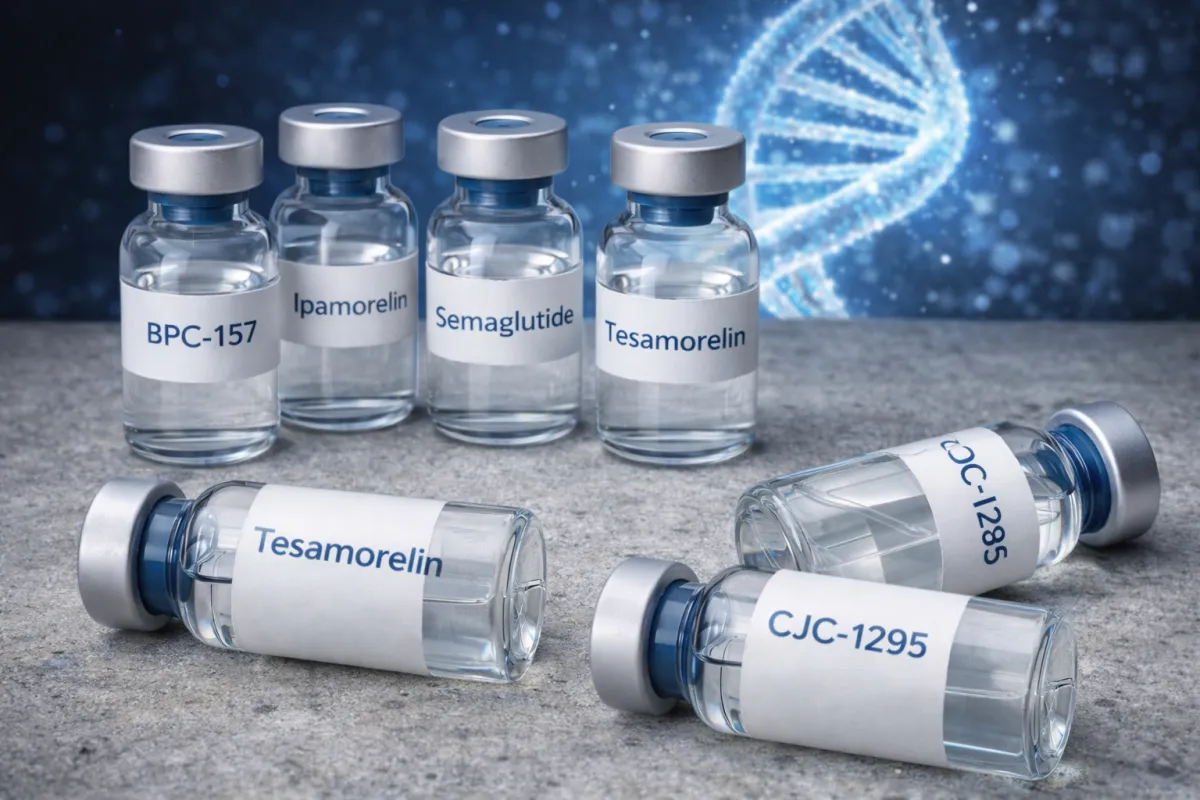
BPC-157
BPC-157 (Body Protection Compound-157) is a peptide derived from protective proteins found in the stomach that is associated with the body’s natural repair processes. In a functional medicine setting, it is commonly used to support tissue healing—particularly for tendons, ligaments, muscles, and digestive health—as part of a broader strategy to enhance recovery and regenerative wellness.
BPC-157
BPC-157 (Body Protection Compound-157) is a peptide derived from protective proteins found in the stomach that is associated with the body’s natural repair processes. In a functional medicine setting, it is commonly used to support tissue healing—particularly for tendons, ligaments, muscles, and digestive health—as part of a broader strategy to enhance recovery and regenerative wellness.
TB-500 (Thymosin Beta-4 fragment)
TB-500 is related to a naturally occurring peptide involved in cellular migration and tissue repair. It is often discussed in regenerative contexts for supporting muscle recovery, connective tissue healing, and reducing inflammation.
CJC-1295
CJC-1295 is a peptide that influences growth hormone signaling by stimulating the body’s natural release of growth hormone. It is often used in longevity and metabolic optimization programs to support recovery, sleep quality, and body composition..
Ipamorelin
Ipamorelin is a growth hormone–releasing peptide that works by mimicking the body’s ghrelin signaling pathway. It is commonly paired with CJC-1295 to support natural growth hormone pulses related to tissue repair, metabolism, and healthy aging.
AOD-9604
AOD-9604 is a fragment of human growth hormone designed to influence fat metabolism without affecting growth hormone levels broadly. It is commonly discussed in metabolic and weight-management programs.
Thymosin Alpha-1
Thymosin Alpha-1 is an immune-modulating peptide that plays a role in supporting T-cell function and immune system regulation. It has been studied in contexts related to immune resilience and inflammatory balance.
GHK-Cu
GHK-Cu is a naturally occurring copper-binding peptide found in plasma and skin. It is widely used in aesthetic medicine for skin regeneration, collagen stimulation, wound healing, and hair follicle support.
MOTS-c
MOTS-c is a mitochondrial-derived peptide that appears to influence cellular metabolism and energy regulation. It is often discussed in longevity and metabolic research for its potential role in improving metabolic efficiency and insulin sensitivity.
Epitalon
Epitalon is a synthetic peptide related to epithalamin and has been studied for its potential influence on cellular aging mechanisms, including telomere regulation and circadian rhythm support.

Memberships
Wellness packages & Specials

Online Store
Xcellment


Opening hours
M: 1pm - 6pm
T: 9 am - 6 pm
W: -
T: 9 am - 6 pm
F: 1 pm - 6pm
S: 9am - 1pm
Popular treatments
Chiropractic Care
Massage
Weight Management
Functional Medicine
Important links
© 2026 LeGrand Wellness - All Rights Reserved.
